If you are wondering is IPTV legal, the short answer is: IPTV technology itself is legal, but an IPTV service can be illegal if it distributes copyrighted content without the necessary authorization.
That distinction is important. IPTV simply describes television or video delivered over an internet connection. The legal question is not whether a service uses IPTV technology, but whether it has the appropriate rights to provide the channels, movies, sports, shows, or other content it offers.
Safety is a separate issue. Even when you are not concerned about copyright, an IPTV service can still present consumer risks if it uses suspicious websites, unsafe applications, unclear billing practices, or poor data-security practices.
For viewers in the United States, the safest approach is to evaluate both the provider’s content rights and the provider’s business practices before subscribing.
Table of Contents
Is IPTV Legal in the USA?
Yes, IPTV technology is legal in the United States.
What matters is how the technology is used and whether the provider is authorized to distribute the content it offers.
For example, a legitimate service can use internet-based delivery to provide television channels or video content to customers. There is nothing inherently illegal about delivering television over the internet.
The problem arises when a provider retransmits copyrighted programming without permission from the relevant copyright owner or rights holder.
The U.S. Copyright Office has explained that unauthorized streaming can implicate the copyright owner’s public-performance right. In other words, streaming technology can have perfectly legitimate uses, but unauthorized retransmission of copyrighted programming can create copyright issues.
So when asking “Is IPTV legal in the USA?”, the better question is:
Does the IPTV provider have the appropriate rights or authorization to distribute the content it provides?
That is much more useful than treating IPTV as either universally legal or universally illegal.
What Makes an IPTV Service Legal or Illegal?
The legality of an IPTV service generally depends on the rights behind its content and how that content is distributed.

What legal IPTV providers generally have
A legitimate IPTV provider should be able to operate transparently and have appropriate authorization for the content it distributes.
Depending on the service, this can involve licensing or other distribution agreements covering channels, programs, movies, sports, or other media.
Other signs of a legitimate business can include:
- A clearly identified company or service operator
- Transparent terms of service
- A privacy policy
- Clear subscription and billing information
- A straightforward cancellation process
- Information about the service and what it provides
- Appropriate authorization for the content being offered
These characteristics do not, by themselves, prove that a provider has every required license. However, transparency makes it easier for consumers to understand who they are dealing with and what they are purchasing.
What can make an IPTV service illegal?
A service can create serious copyright concerns when it provides copyrighted programming without authorization from the relevant rights holders.
This can include unauthorized retransmission of:
- Premium television channels
- Movies
- Live sports
- Pay-per-view events
- Subscription-based programming
- Other copyrighted audiovisual content
U.S. copyright law also contains specific provisions addressing certain illicit digital transmission services operated for commercial advantage or financial gain.
The important point is that the technology does not determine legality by itself. The content rights and the way the service operates matter.
Is IPTV Safe to Use?
The question “Is IPTV safe?” has two different meanings.

First, you may be asking whether using an IPTV service creates legal or copyright concerns.
Second, you may be asking whether the service is technically and financially safe.
These should not be confused.
A service could present copyright concerns without every aspect of its website being technically malicious. Conversely, a service could appear legitimate while still having poor security, questionable billing practices, or unsafe downloads.
Before subscribing, consider both dimensions.
Watch out for suspicious IPTV websites
Be cautious if a provider’s website:
- Uses aggressive pop-ups or redirects
- Requests unnecessary personal information
- Has no clear business identity
- Provides no meaningful terms or privacy policy
- Uses suspicious payment pages
- Pressures you to purchase immediately
- Makes unrealistic promises about its service
- Directs you to download unknown applications or files
A professional-looking website is not proof that a service is legitimate. Likewise, a low price is not automatically evidence of piracy.
The goal is to look at the overall picture.
Be careful with unknown IPTV apps and downloads
One of the biggest practical safety concerns is downloading software from unknown sources.
If an IPTV provider tells you to install an application from an unfamiliar website, do not assume that the application is safe simply because it is described as an IPTV player.
Before installing software, consider:
- Who developed it?
- Where is it being downloaded from?
- Does the provider identify the application clearly?
- Does your device recognize or trust the source?
- Are you being asked to disable security protections?
- Does the application request permissions that seem unrelated to its purpose?
Never disable important device security features simply because a website tells you to.
How to Tell if an IPTV Provider Is Legitimate
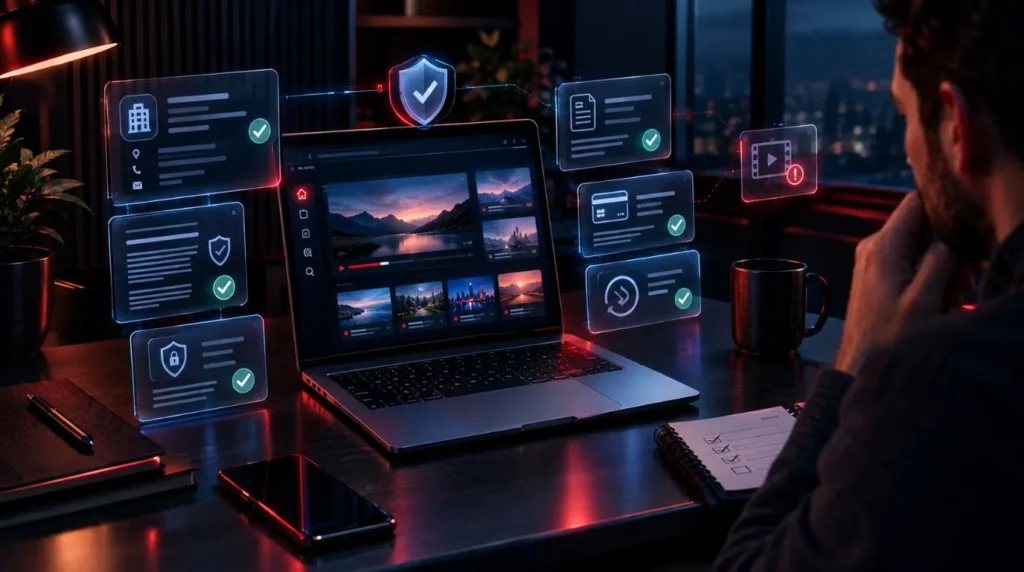
There is no single visual clue that can prove an IPTV provider is legitimate. Instead, evaluate the service before giving it your money or personal information.
1. Check who operates the service
Look for clear business information.
A provider that gives customers no meaningful information about who operates the service deserves additional scrutiny.
Look for:
- Business or company information
- A working contact method
- Terms of service
- Privacy information
- Refund or cancellation policies
- Clear subscription details
An anonymous operation is not automatically illegal, but it makes it much harder for a customer to evaluate the business.
2. Look at the content being offered
Consider whether the provider explains its content offering clearly.
Be particularly cautious when a service claims to provide an enormous selection of premium channels, major sports packages, movies, and other subscription content for an unusually low price without explaining how the content is licensed.
That does not prove the service is illegal on its own. It is a reason to investigate further.
3. Review the pricing and subscription terms
Before paying, understand:
- How much the subscription costs
- Whether it renews automatically
- When you will be charged
- How cancellation works
- Whether refunds are available
- What happens when a trial ends
The FTC recommends checking subscription terms before signing up, understanding automatic renewals, and making sure you know how to cancel.
4. Research the provider
Search for the provider’s name along with terms such as:
- “complaint”
- “scam”
- “refund”
- “cancellation”
- “billing”
You should not rely on one review or one website. Look for patterns across multiple sources.
A history of unexplained charges, inaccessible customer support, or repeated complaints about cancellation should make you cautious.
Illegal IPTV Warning Signs to Watch For
The phrase illegal IPTV is often used broadly online, but not every suspicious-looking service can be conclusively classified as illegal based on one characteristic.
Instead, look for combinations of warning signs.
Potential red flags include:
- Premium content offered at an implausibly low price
- Claims of access to virtually every premium channel or sports package
- No identifiable business behind the service
- No terms of service or privacy policy
- No explanation of the service’s content rights
- Constantly changing websites or domains
- Pressure to pay immediately
- Unusual payment methods
- Suspicious third-party applications
- Websites filled with misleading redirects or pop-ups
- Claims that a service can provide content from numerous paid platforms in one extremely cheap package
Again, these are warning signs, not a legal test.
The most important question remains whether the provider has the necessary authorization to distribute the content.
What Is IPTV Piracy?
IPTV piracy generally refers to the unauthorized distribution or retransmission of copyrighted television, movies, sports, or other content through internet-based services.
The technology used to deliver the stream is not what makes the activity piracy.
The problem is the unauthorized use or distribution of copyrighted content.
For example, an internet-based television service can be perfectly legitimate when it has the necessary rights to distribute its programming. On the other hand, retransmitting paid television channels or other copyrighted programming without authorization can infringe copyright.
The U.S. Copyright Office has specifically recognized that unauthorized streaming can implicate copyright owners’ exclusive public-performance rights.
This is why consumers should not assume that every service describing itself as an “IPTV provider” operates in the same way.
Are IPTV Users Breaking the Law?
This is one of the most complicated questions because copyright law can involve different types of conduct, and the legal consequences can depend on the specific circumstances.
It would be misleading to say that every person who watches an unauthorized IPTV stream automatically faces the same legal consequences as the operator providing it.
The more important distinction is between the consumer and the businesses or individuals that operate unauthorized distribution services.
U.S. authorities have long recognized the copyright implications of unauthorized streaming, particularly where copyrighted programming is retransmitted without permission. Federal law also contains provisions addressing certain commercial illicit digital transmission services.
If you are concerned about a particular legal situation, a qualified attorney is the appropriate source for advice about your circumstances.
For ordinary consumers, the practical takeaway is simple:
Choose services that have a legitimate basis for distributing the content they offer rather than knowingly relying on unauthorized sources.
How to Choose a Safer IPTV Service
Once you understand the difference between IPTV technology and unauthorized IPTV distribution, choosing a service becomes much easier.
Use this checklist before subscribing.
Look for transparency
A trustworthy service should clearly explain what it offers and how customers can use it.
You should be able to find basic information about the service, its policies, pricing, and support.
Review the subscription terms
Don’t skip the small print.
Confirm:
- The total price
- Billing frequency
- Renewal terms
- Trial duration
- Cancellation procedure
- Refund conditions
The FTC specifically recommends understanding free-trial and automatic-renewal terms before providing payment information.
Use secure payment practices
Be cautious if a provider asks for unnecessary financial information or directs you to an unfamiliar payment page.
Keep records of your purchase confirmation and monitor your payment account for unexpected charges.
If you discover unauthorized subscription charges and the provider will not resolve the problem, the FTC recommends contacting your card issuer about disputing the charge and reporting the issue where appropriate.
Don’t install suspicious software
An IPTV service should not require you to compromise your device’s security.
Avoid unknown downloads, suspicious APK files, or instructions telling you to disable security protections.
If you are looking for information about setting up IPTV on your device, you can also refer to ViviMate’s IPTV setup guide for general setup information.
Research before paying
A few minutes of research can help you avoid a poor subscription decision.
Look beyond the provider’s own marketing and investigate its reputation, policies, customer support, and business identity.
Legal IPTV Providers vs. Questionable Services
The following comparison can help you evaluate what you encounter online:
| What to look for | More reassuring | Reason for caution |
|---|---|---|
| Business identity | Clear and transparent | Anonymous or difficult to identify |
| Content | Clear information about the service | Extremely broad premium catalog with no explanation |
| Pricing | Understandable pricing | Unrealistically cheap for what is offered |
| Billing | Clear renewal and cancellation terms | Confusing or hidden billing |
| Website | Professional, transparent information | Redirects, pop-ups, or missing policies |
| Software | Clear source and identifiable application | Unknown downloads or suspicious files |
| Customer support | Accessible support channels | No reliable way to contact the provider |
This table should be treated as a consumer checklist, not a legal determination.
A provider can only be properly assessed in light of its actual licensing, business practices, and the content it distributes.
What About IPTV Apps and IPTV Players?
It is also important to distinguish an IPTV player from an IPTV content provider.
An IPTV player is generally software used to play or organize streams supplied by a user or service. The application itself does not necessarily determine whether the content being accessed is authorized.
In other words:
An IPTV player and an IPTV service are not automatically the same thing.
If you are researching the software side of IPTV, you can learn more about choosing an appropriate IPTV player.
The same principle applies to devices. A smart TV, streaming device, phone, tablet, or computer can be used for both legitimate and unauthorized streaming. The device itself does not determine the copyright status of the content.
A Simple Checklist Before You Subscribe
Before purchasing an IPTV subscription, ask yourself:
- Do I know who operates the service?
- Are the subscription terms easy to understand?
- Is the price realistic for what is being offered?
- Does the provider give me clear information about its service?
- Can I find a privacy policy and terms of service?
- Do I understand how cancellation works?
- Does the service require suspicious software or downloads?
- Does the website use unusual payment methods or pressure tactics?
- Does the provider appear transparent about the content it offers?
- Have I researched the company beyond its own website?
If several answers raise concerns, stop and investigate before paying.
So, Is IPTV Legal and Safe?
IPTV itself is legal. It is simply a way of delivering television and video content over the internet.
What can make an IPTV service unlawful is the unauthorized distribution of copyrighted content. In the United States, unauthorized streaming can implicate copyright rights, including the public-performance right.
Safety is a separate consideration. Before subscribing, evaluate the provider’s transparency, billing practices, software, website, customer support, and overall business reputation.
The safest approach is not to assume that every IPTV service is either legitimate or illegal. Evaluate the specific provider, the content it offers, and the way the service operates.
If you’re researching IPTV services and want to understand the broader options available, you can explore ViviMate and review the service information before deciding whether it fits your needs.
This article provides general educational information and is not legal advice. Copyright and other laws can vary depending on the circumstances and jurisdiction. If you need advice about a specific legal situation, consult a qualified attorney.